What to see around Bari
CASTEL DEL MONTE (60 Km da Bari)
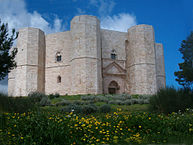
"Castel del Monte giu06 001" di Marcok di it.wikipedia.org
Opera propria. Con licenza CC BY-SA 2.5 tramite Wikimedia Commons.
Castel del Monte is a building of the eighteenth century, built by Emperor Frederick II in Apulia, 18 km from the town of Andria, near the town of Santa Maria del Monte, in the province of Barletta-Andria-Trani.
It is located on a hill on the western chain of the Murge, 540 meters above sea level. It has been listed as Italians national monuments in 1936 and in UNESCO World Heritage Sites in 1996.
The origin of the building is placed officially on Jan. 29, 1240, when Frederick II Hohenstaufen ordered to Riccardo Montefuscolo, which were prepared and all the necessary materials for the construction of a house near the church of Sancta Maria de Monte (now lost). This date, however, is not accepted by all scholars, according to some, in fact, by that date the construction of the castle had already reached the roofs.
Unclear is also the attribution to a specific architect: some attribute the work to Richard of Lentini but many argue that to design the building was the same Frederick II. It seems that it was built over the ruins of a previous fortress before Lombard and then Norman. Probably at the time of the death of Frederick II (in 1250) the building was not yet finished.
It was rarely used as a hall for parties; among these in 1246 the wedding of Violante, daughter of Frederick and Bianca Lancia with the Count of Caserta Riccardo Sanseverino.
By the seventeenth century followed a long period of abandonment, the castle was stripped of all furniture and wall decorations of marble (whose traces are still visible just behind the capitals) and became a prison as well as a shelter for shepherds, bandits and political refugees. In 1876 the castle, in extremely precarious conditions of conservation, was finally purchased (at the price of £ 25,000) by the Italian State, which predispose the restoration since 1879. In 1928 the restoration directed by the architect Quagliati removed material outside the castle and demolished the structures unsafe, reconstructing them to give the castle a look "rejuvenated"; This does not halt the deterioration and the castle had to undertake further restoration between 1975 and 1981. In 1936 Castel del Monte was declared a national monument.
In 1996 UNESCO included it in the list of World Heritage Sites, for the astronomical and mathematical rigor of its shapes and for the harmonious union of cultural elements from northern Europe, the Muslim world and classical antiquity, a typical example of architecture of the Middle Ages.
The castle is built directly on bedrock, in many places outcrops, and is universally known for its octagonal shape. On each of the eight corners are grafted eight towers of the same shape in the curtain walls of local limestone, marked by a string course, they are eight mullioned windows on the lower floor, seven mullioned windows and only one mullioned window, facing Andria, in the upper one.
GROTTE DI CASTELLANA (40 Km da Bari)
.jpg)
"Grotte Castellana (5)" di ReMagio di Wikipedia in italiano
Trasferito da it.wikipedia su Commons da Marcok. Con licenza Pubblico dominio tramite Wikimedia Commons.
Castellana Caves - a complex of underground karst cavities, typical tourist sites, among the most beautiful and spectacular in Italy - are located in the municipality of Castellana Grotte, about 1.5 km from the town.
They have a length of 3348 meters and reach a maximum depth of 122 meters from the surface. The temperature of the interior is around 16.5 ° C.
Located right next to the Itria Valley, not far from charming towns like Alberobello, Cisternino, Polignano a Mare, Castellana Caves are in the southeastern Murge - to 330 m above sea level - and formed in the Upper Cretaceous, about ninety-one hundred million years ago.
The natural entrance to the cave is a huge sixty meters deep chasm called La Grave. The visit to the public runs along a scenario for about 1 km. The longer route, takes two hours and runs for 3 km, among caves and chasms that have names mythological or fantastic. From the Grave Black Cave or the Capitoline Wolf, after passing the cave of Monuments, passed the Sock and then the Cave of Civetta, crossed the corridor of the Snake, the Cave of the Precipice and the Little Heaven, it is flowing to the long corridor Desert also known as Underground Grand Canyon (the reddish color is due to the presence of the ore) to reach the Cave of the Tower of Pisa, the clear Lake of water, the Red Corridor, the Cave of the Dome and finally passing from shimmering Lake of crystals, for reaching the White Grotto, a radiant and glowing cavity.
There are also eccentric stalactites that seem to violate the law of gravity.
The beauty of the Castellana Caves attracts visitors from all over the world, and from the day of their opening to the public, more than 15 million people have walked its streets underground. The visit to the Caves winds along a 3 km: an extraordinary guided tour, about 70 meters deep, in a stunning scenery, where the names fantastic caves, canyons, deep chasms, fossils, stalactites, stalagmites, concretions shapes incredible and amazing colors solicit the imagination of children and adults.
Castellana Caves are, therefore, fully, a good opportunity to admire one of the most amazing natural in wonderful Apulia..
ALBEROBELLO (50 Km da Bari)
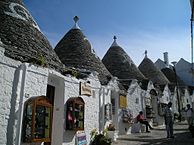
"Trullialberobello" di Verity Cridland - flickr.
Con licenza CC BY 2.0 tramite Wikimedia Commons.
Alberobello is a town in the Murgia Hill in the province of Bari, approximately 10,000 inhabitants, declared a World Heritage Site by UNESCO in 1996; It sits in the Valle d'Itria and is located midway between the Adriatic Sea and the Ionian Sea. The new city is on the eastern hill, with modern architectural features, while on the other side, the old town line up the "Trulli" in an urban area divided into two districts: "Monti" and "Aia Piccola", both national monument.
The "Trulli" are an architectural example of universal value, since they constitute a unique testimony, or at least exceptional, of a civilization or a cultural tradition disappeared and offer an example of a type of building or architectural ensemble that illustrates a significant stage of human history.
Trulli (from the Latin Turris, Trulli, or from the greek tholos, or from greek-Byzantine torullosa, all significant Dome) are typical of the buildings came down through a thousand-year tradition until our own day.
They share with the dwellings of primitive peoples, the external form: a cylinder topped by a cone, but everything else is an original construction.
Trulli are interely built of stone, people didn't use mortar, or wood, or other means for supporting or connecting.
Primitive is the form, primitive are the means, but not primitive is the art with which these simple means was used to reach an admirable static.
The crudest form of the Trulli contrasts with the ingenious solution of the problem of static, and can be solved only by people neither savages nor primitive.
Stereotomy (the science that studies the forms to give to the elements of a factory to make it solid) was born before the time of construction of the trulli. But the simple resolution of a major problem of static was particularly facilitated, in the construction of the trulli, by the geological nature of the area, made up of barren hills, almost covered by a layer of limestone that flakes in layers of different thickness, to provide plates smooth and with parallel faces.
LOCOROTONDO (65 Km da Bari)

"Foto Panorama di Locorotondo".
Con licenza CC BY-SA 4.0 tramite Wikipedia.
The white Locorotondo is the most beautiful balcony of the “Trulli Valley”. From its belvedere you can admire an area that is at times exciting: a mosaic of small vineyards marked by dry stone walls, patches of Mediterranean woodland and silvery olive groves that surround ancient farmhouses, thousands of trulli scattered throughout the districts. In addition, the small ancient nucleus of Locorotondo, enclosed in its circular perfection of stones and lime, once marked by the walls, seems suspended between dream and reality: the white of the lime envelops everything, it acts as a dazzling background to the stone Baroque architecture local, enhances the spots of the intense color of flowered balconies.
TRANI (45 Km da Bari)
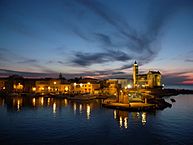
"Foto Trani cattedrale dal fortino".
Con licenza Pubblico dominio tramite Wikipedia.


Trani is an Italian town of 56,236 inhabitants of the capital, along with Barletta and Andria, Province of Barletta-Andria-Trani, in Puglia.
The city, also known as "the pearl of the Adriatic", is famous for its Romanesque cathedral that overlooks the sea, inserted in the list of "Italian Wonderland", as well as for the production of a particular type of marble and for Moscato wine.
The town, un important tourist destination, is rich in artistic and architectural treasures, churches and palaces of every era, evidence of its glorious past. Trani was un important trading center until the sixteenth century, and here was promulgated the first maritime code of the Western world, the Ordinamenta Et Consuetudo Maris in 1063.
The city of Trani, thanks to its ancient history, can claim the title of "City of art" and boast a large artistic and architectural heritage: in addition to the famous cathedral on the sea and the Swabian castle, the city is full of churches and monasteries, as well as of valuable historical buildings. The marina, also of ancient origin, is the setting for some beautiful artistic attractions.
POLIGNANO A MARE (37 Km da Bari)
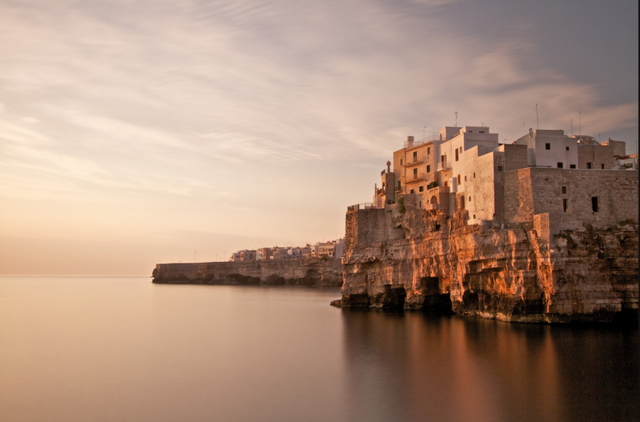
"Polignano1" di polignano.
Con licenza GPL tramite Wikimedia Commons.
Polignano a Mare is an Italian town of 17,986 inhabitants in the metropolitan city of Bari, in Puglia. The oldest part of town lies on a rocky outcrop overlooking the Adriatic Sea 33 kilometers south of the capital.
The country's economy is mainly based on tourism, agriculture and fishing.
Its natural caves are of particular interest, but historically important are the historic center and the remains of Roman rule. Among the latter, the bridge of Via Traiana, still viable, that crosses Lama Monachile, the deep inlet just north of the old town.
The main church dedicated to Santa Maria Assunta, overlooking the small piazza Vittorio Emanuele, the heart of the historical center, was used as a cathedral until 1818, when the small diocese of Polignano was combined with that of Monopoly. Inside the church there are some works attributed to the sculptor Stefano from Putignano, active between the sixteenth and seventeenth centuries, and the important Altarpiece of the Madonna with Child and Saints, of the fifteenth century on golden wood of Bartolomeo Vivarini, as well as a multitude of other small works and precious vestments donated by the former Monastery of St. Benedict, today nonexistent. In the little town of San Vito, on the coast north of the country, just behind the marina, stands the imposing Benedictine abbey. In addition, within the territory of Polignano there are some estates: typical buildings dating from the seventeenth and the eighteenth century, used as farms of large landowners.
Of great interest, for lovers of contemporary art, there is the Museo Pino Pascali, located in a former slaughterhouse of 18° century, situated just on the waterfront.
Since 2008, Polignano a Mare has always received the Blue Flag, award given by the Foundation for Environmental Education for European coastal resorts that meet quality criteria related to parameters of bathing water and to the service offered.
MATERA (70 Km da Bari)
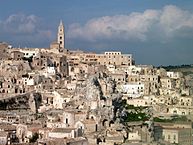
"Matera boenisch nov 2005" di Bönisch -
photo taken by Bönisch. Con licenza CC BY-SA 2.0 de tramite Wikimedia Commons.
Matera is a town of 60,453 inhabitants, capital of the province and second city of Basilicata for the population, and the largest common area of Basilicata.
From 1663 to 1806 was the capital of Giustizierato of Basilicata in the Kingdom of Naples. During this period the city experienced a significant economic, commercial and cultural increase.
Known as "Stone City" or "Underground City", it is better known for its historians Sassi, who are one of the oldest residential areas in the world. The Sassi were recognized in 1993 by UNESCO World Heritage, the first site in southern Italy to receive such recognition.
Matera is one of the city decorated for Valor for the Liberation War for the sacrifices of its people during the Second World War, being the first city in the south of Italy to rise in arms against fascism.
In 1954 the city was proclaimed "Civitas Mariae" by the Archbishop. Saint John Paul II called it the city of the Visitation and the Magnificat.
The October 17, 2014 Matera was designated, with Plovdiv as European Capital of Culture 2019, the first city in the southern Italian to receive this title.
LECCE (150 Km da Bari)
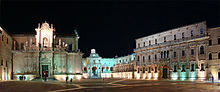
"Puglia Lecce1 tango7174" di Tango7174
Opera propria. Con licenza GFDL tramite Wikimedia Commons.
Lecce is an Italian town of 94,148 inhabitants, capital of the province in Puglia. Located in almost central position of the Salento peninsula, it is the center of a vast area of about 500,000 inhabitants, including 31 municipalities in the northern part of the province. It is located 11 kilometers from the Adriatic coast and 23 from the Ionian and is the capital of the easternmost province of Italy.
Art Cities of Southern Italian, Lecce is known as the "Florence of the South" or the "Florence of the Baroque": the ancient Messapian origins and the archaeological remains of Roman rule, mingle with the richness and exuberance of Baroque of the churches and buildings in the center, built in local stone, a soft limestone, compact, with warm colors and golden, that lends itself very well to working with the stonemason. Architectural development and enrichment of the decorative facades has been especially fruitful in the Kingdom of Naples and has characterized the city, as to take the definition of Baroque of Lecce. It was among the six Italian cities candidate for European Capital of Culture for the year 2019, and was "Italian Capital of Culture" in 2015. Lecce is a city of the greatest density of resources and monuments of Puglia. It is rich in works of art and of Roman, medieval and Renaissance.